
We are all responsive to nature. If it’s raining, we shelter ourselves with an umbrella, if it’s cold, we shield ourselves with warm clothes, and in scorching hot summers, we switch to coolants, which is what nature revolves around, the ecosystem of seasons that marks the change.
The replica of this ecosystem can be seen in the architecture we see around the world, and if not so far, the diversity can be seen in the country itself. Architecture, in simple words, is defined as functional, responsive, and expressive. Just as you dress according to the weather, architecture is dressed accordingly.
The responsiveness of architecture doesn’t rely solely on structure but also on the cultural aspect of the region. Architecture continues dialogue not as a monologue of form, but as a living conversation between the people who build, the land that receives, and the time that witnesses. Culture is not an ornament applied to a building as a fact; it is the very grammar in which architecture speaks.
Walk through the narrow, winding lanes of Rajasthan, and you will find thick mud walls that absorb the desert heat by day and release it slowly through the night. The jharokha, the overhanging enclosed balcony, catches the faintest desert breeze while shielding its occupant from the punishing sun. Move east to Bengal, and the architecture shifts entirely. Homes rise on stilts, their roofs pitched steep and wide, shedding the monsoon’s weight with practiced ease. The land breathes differently here, and so do its buildings.
Travel to the Mediterranean coast of Greece, and the logic is different again but equally exact. The whitewashed walls of Santorini are not painted white for beauty alone. White reflects the fierce Aegean sun, keeping the stone beneath cool through the long dry summer. Walls are thick, windows are small and deep set, and homes are carved into the hillside itself, borrowing the earth’s natural insulation. The famous blue domes above are oriented to catch the prevailing sea breeze, drawing cooler air through the interior without a single mechanical system. Every choice that looks like style is, underneath, a climate decision made so many times over so many centuries that it has become identity.
Some may call it early awareness, some may call it the regional style or some may label it as climate responsive but its not about just the labels its about how the architecture blends with the environment around it
Here are 7 Climate Responsive Buildings Across Different Countries That are New in Form but Responsive to its Culture, Climate and Surroundings
1. Pearl Academy of Fashion – Jaipur, India
Morphogenesis
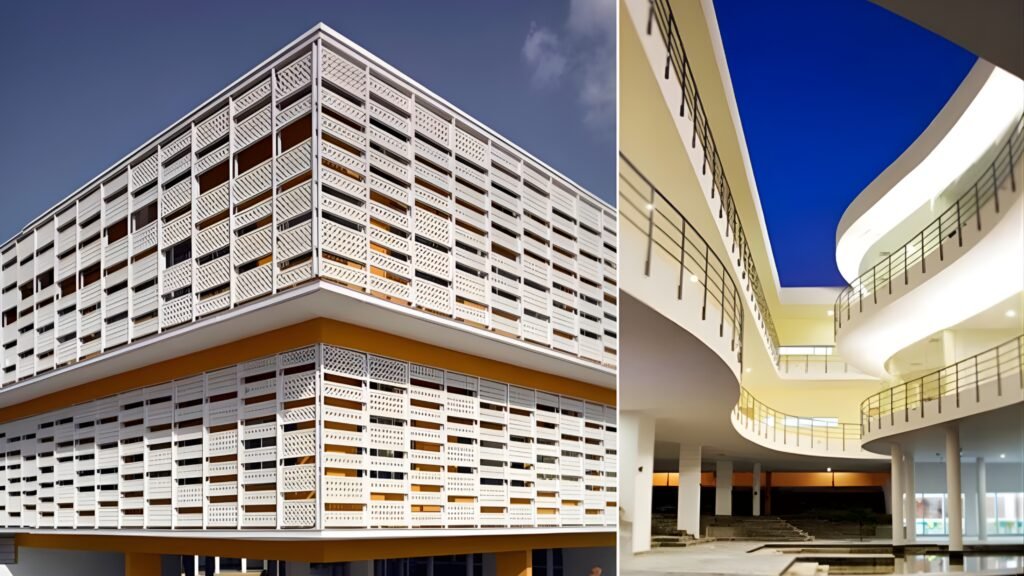
A climate-responsive campus in Jaipur that reinterprets traditional Rajasthani architecture through shaded courtyards, jaalis, and passive cooling to harmonize with its cultural and desert context.
Designed by Morphogenesis, the Pearl Academy draws its central form from the baoli the ancient Rajasthani stepwell translating a thousand-year-old climate typology into a contemporary campus. A sunken courtyard harnesses earth-contact cooling, jaali screens filter the desert sun while permitting ventilation, and water bodies cool incoming air through evaporation, together reducing cooling energy by roughly 40% with no conventional air conditioning.
The sandstone palette echoes Jaipur’s Pink City, and the inward-looking plan mirrors the haveli tradition a shaded private world behind a modest street face. Climate logic and cultural identity are the same gesture here; neither can be removed without undoing the other.
2. The Edge Amsterdam, Netherlands
PLP Architecture
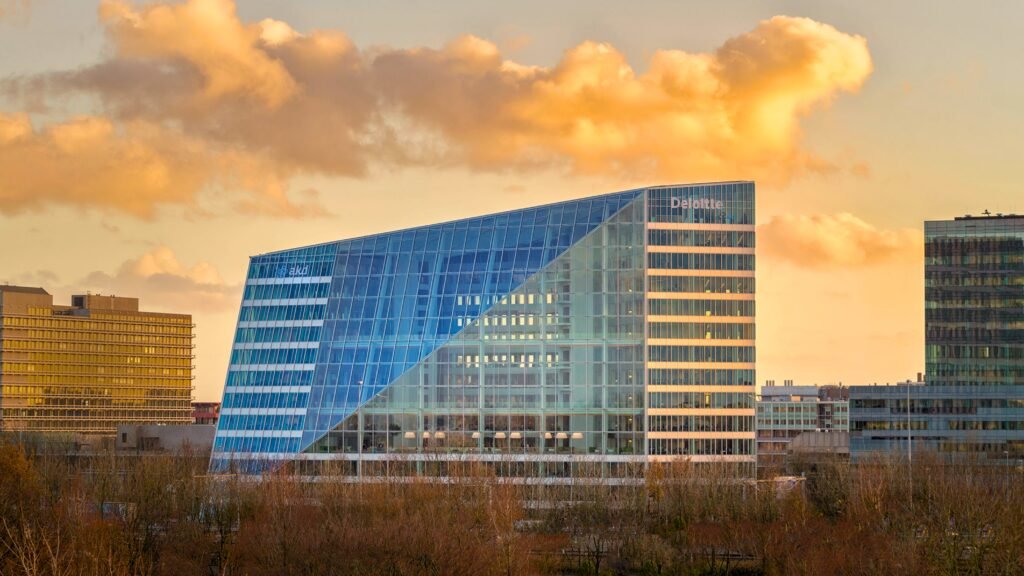
The Edge – Amsterdam, Netherlands: A highly intelligent, energy-efficient workplace in Amsterdam that integrates smart technology and sustainable design to respond intuitively to its users and environment.
The Edge uses a double-skin façade as a climate buffer against Amsterdam’s damp, wind-prone conditions, trapping a layer of air that moderates both heat loss in winter and solar gain in summer. A dense sensor network adjusts shading and ventilation in real time, and rainwater harvested from the roof supplies all toilet flushing — the building reads its environment continuously rather than simply sitting in it.
Culturally it reflects the Dutch tradition of rigorous, transparent environmental management. Its open atrium continues the spatial language of the market hall — a bright civic interior that spills life toward the street.
3. Bahrain World Trade Center – Manama, Bahrain
Atkins
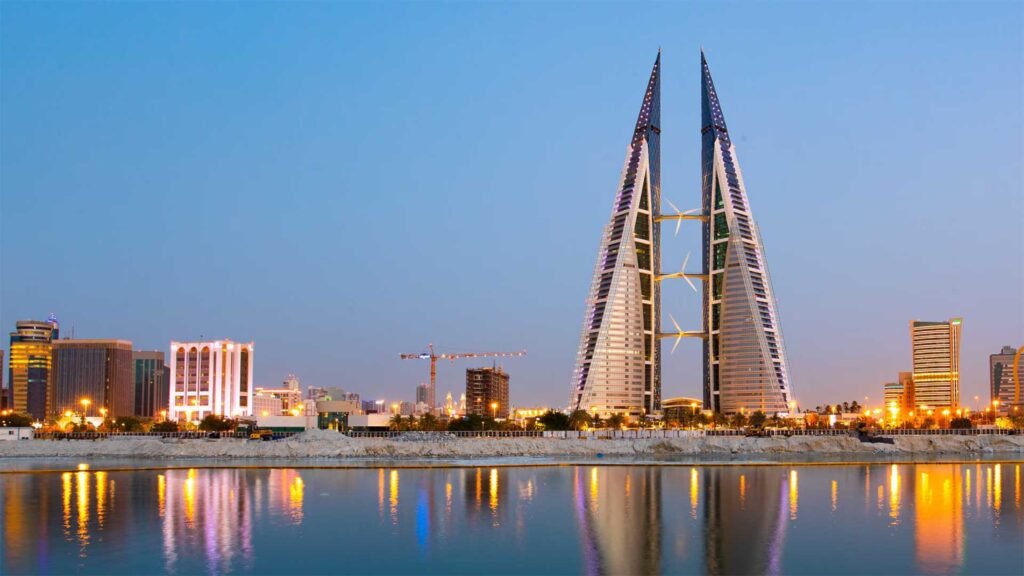
Bahrain World Trade Center – Manama, Bahrain: An iconic twin-tower in Manama that harnesses prevailing Gulf winds through integrated turbines, merging regional identity with renewable energy innovation.
The twin towers are aerodynamically profiled as aerofoils, shaped to funnel the Gulf’s prevailing northwest sea breeze through the gap between them and into three 29-metre wind turbines at sky-bridge levels. The form that generates energy is the same form that evokes the billowing sail and dhow the vessel central to Bahraini maritime identity, so the building’s climate logic and cultural symbolism are one and the same.
Oriented precisely to the local wind rose, the towers frame the sea view and create a threshold between the city and the water, a role historically played by the harbour itself.
4. Council House 2 (CH2) – Melbourne, Australia
DesignInc · Variable temperate climate
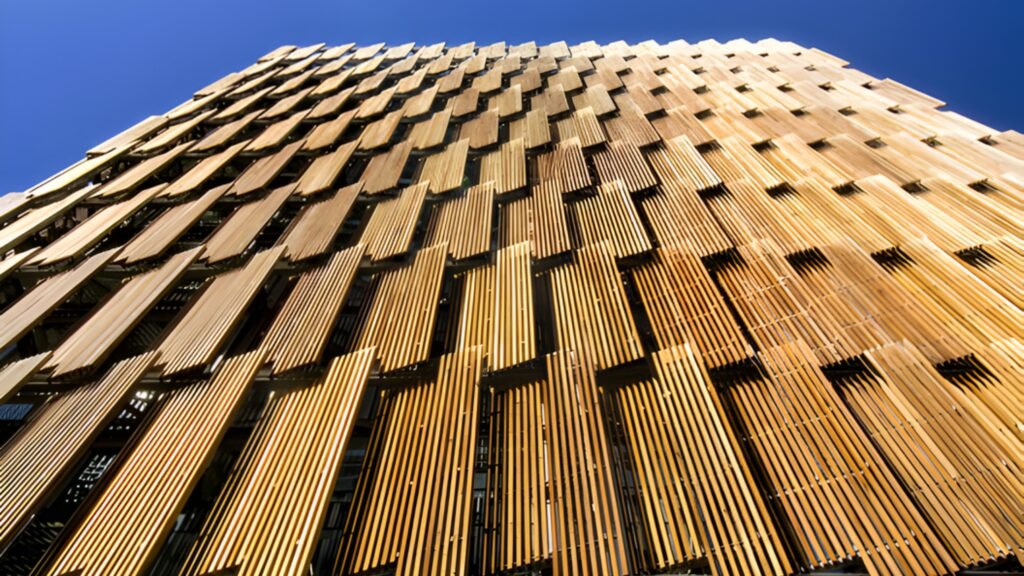
rne, Australia: A pioneering green building in Melbourne that responds to climate through natural ventilation, shading systems, and recycled materials for a healthier workplace.
Melbourne’s notoriously unpredictable climate demanded a layered response. Rotating timber louvers track the sun through the day, concrete slabs absorb daytime heat and are flushed cool by night air, a green roof manages stormwater, and operable windows return control to occupants. The building works with the city’s temperature swings rather than fighting them.
Its interiors deliberately blur the line between office and garden, reflecting an Australian civic ideal of informality and democratic access to daylight. Standing next to its Victorian predecessor, CH2 chooses dialogue over mimicry — different materials, same street scale, same civic address.
Also Read – Why Every Architect Should Travel at Least Once a Year
5. CopenHill (Amager Bakke) – Copenhagen, Denmark
BIG
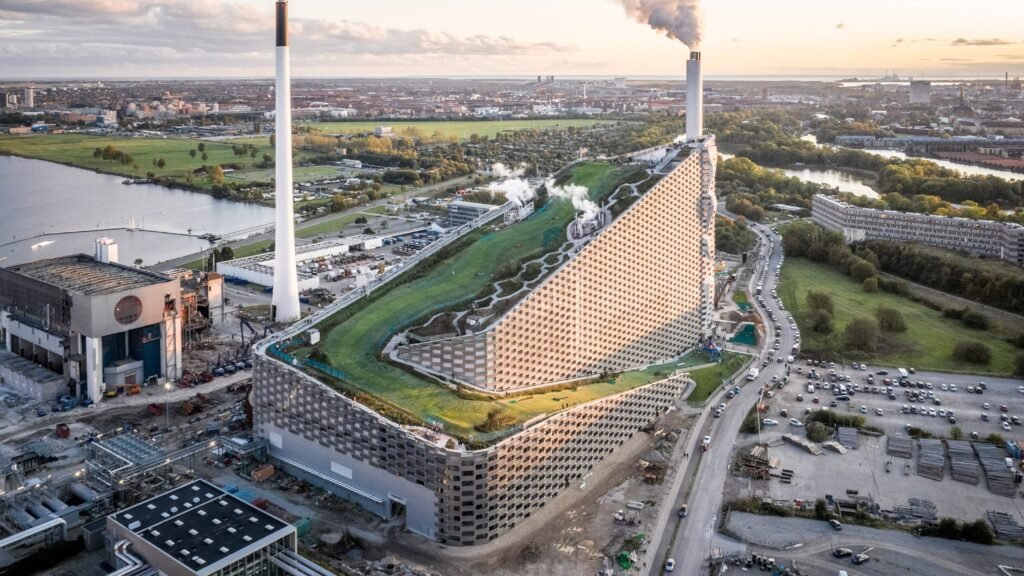
CopenHill (Amager Bakke) -Copenhagen, Denmark: A waste-to-energy plant in Copenhagen that transforms industrial infrastructure into a public landscape, blending sustainability with urban recreation.
A waste-to-energy plant whose sloped vegetated roof insulates the building, intercepts heavy Nordic rainfall, and reduces the urban heat island in a dense harbour district — while also functioning as Copenhagen’s only ski slope and public hiking trail. Infrastructure, climate system, and city park occupy the same surface.
The ski slope is not a gimmick. Danes are committed outdoor people who do not stop moving in winter, and placing a hill in a famously flat city is a direct cultural response. Sited in a formerly industrial neighbourhood, the building has anchored its regeneration and returned the waterfront to public life.
.
6. Google Bay View Campus – Mountain View, USA
Heatherwick Studio + BIG
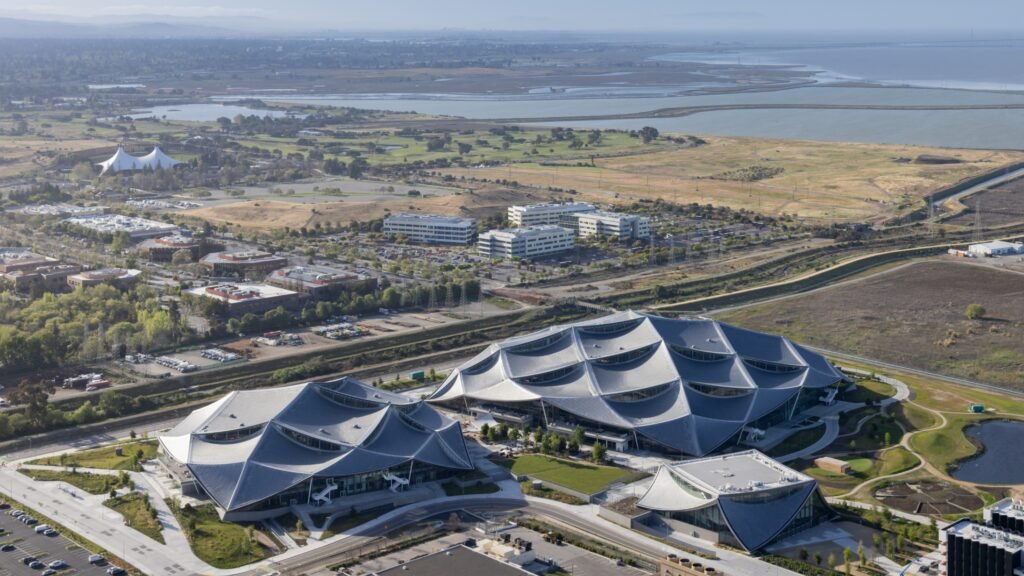
Google Bay View Campus – Mountain View, USA: A nature-integrated campus in Mountain View that prioritizes daylight, ventilation, and adaptable workspaces within a responsive, human-centric environment.
Bay View’s “dragonscale” solar canopy roof — a tessellated skin of photovoltaic panels — generates electricity while giving the campus its identity. Below it, 100% outside-air ventilation runs year-round thanks to Silicon Valley’s mild climate, a geothermal field handles heating and cooling, and on-site water recycling achieves net-zero use in drought-prone California. Native plants cover the landscape, connecting the campus to its regional ecology.
Culturally the campus embodies the Valley’s open, non-hierarchical ideal — all workers share the same sunlit, garden-level workspace. Cycling paths connect directly to the Bay Trail, making the campus boundary porous rather than fortified.
7. One Central Park – Sydney, Australia
Ateliers Jean Nouvel + PTW
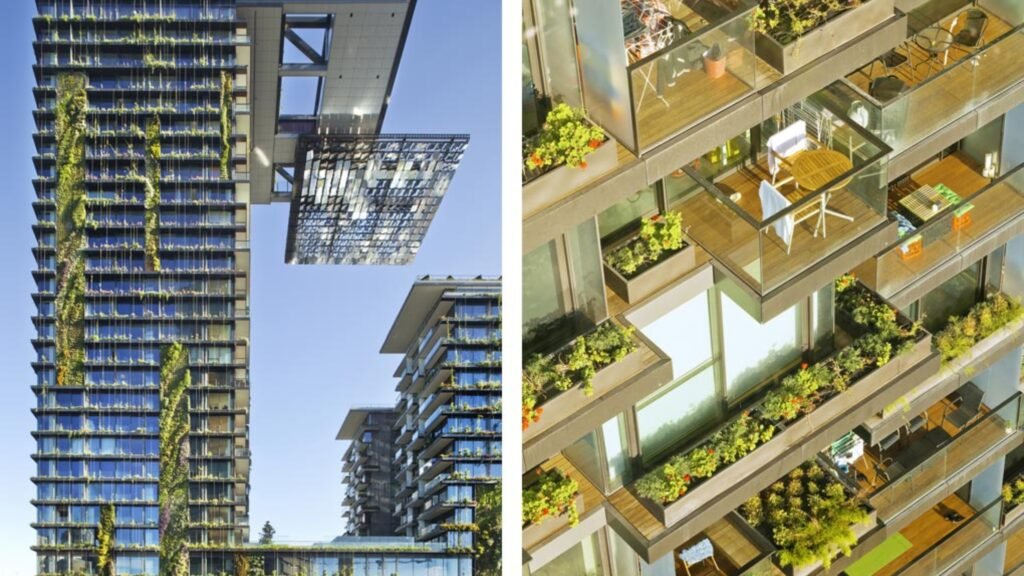
One Central Park -Sydney, Australia: A biophilic landmark in Sydney that weaves vertical gardens and solar innovation into its form, creating a living façade attuned to climate and context.
Thirty-five thousand plants from 350 species cover the façades, providing passive insulation that reduces solar heat gain in Sydney’s humid summers. A cantilevered heliostat on the upper levels redirects sunlight down to shaded lower floors and the public park below, cutting artificial lighting demand while improving the microclimate of the surrounding street.
Bringing hundreds of plant species into a city tower is a cultural act — Australians live in cities but their identity is bound to the natural landscape, and the building keeps that connection present at thirty storeys. It also anchors the regeneration of a formerly industrial neighbourhood, with the park at its base giving the area its first genuine green heart.